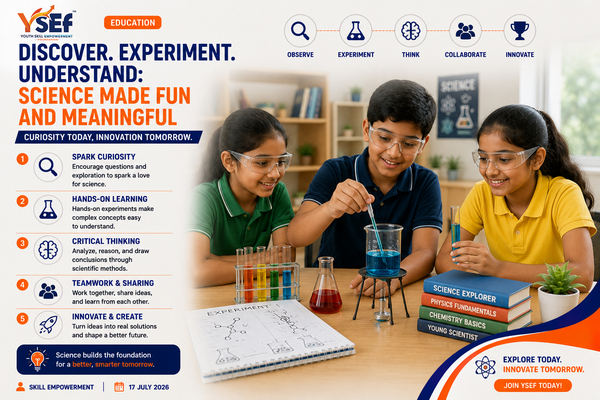
Science often gets reduced to formulas and definitions to memorize before an exam. But real science lives in questions, experiments, and the small "aha" moments that happen when a child sees a reaction unfold right in front of them. At YSEF, we believe science should be discovered, not just read.
- Sparking Curiosity First
- Every experiment starts with a question — why does this happen, what if we change that? Encouraging students to ask before they're told the answer builds a genuine love for science, not just compliance with a syllabus.
- Learning Through Hands-On Experiments
- Watching color change in a beaker or measuring a reaction with their own hands makes abstract concepts click in a way no textbook diagram ever could. Hands-on learning turns complicated ideas into something students can actually see and remember.
- Building Critical Thinking Skills
- Science isn't about memorizing outcomes — it's about observing, analyzing, and drawing conclusions through evidence. Students who practice this habit of reasoning carry it into every subject, not just the science lab.
- Teamwork and Sharing Ideas
- Real scientific discovery rarely happens alone. Working in small groups, comparing observations, and discussing results teaches students to collaborate, listen, and build on each other's thinking.
- Turning Ideas Into Innovation
- The final step of any experiment is asking what comes next — how can this idea be used, improved, or built upon? That mindset of turning curiosity into creation is exactly what shapes tomorrow's innovators.
At YSEF, our science programs are built around this simple cycle — observe, experiment, think, collaborate, and innovate. Because science built the right way doesn't just teach facts; it builds the foundation for a smarter, more curious future. Explore our programs and give your child a genuine head start.